The Future of Battlefield: Why 2143 Could Be the Franchise's Lifeline
Looking back from the vantage point of 2026, the struggles of the Battlefield franchise have been a long and winding road. The release of Battlefield 2042 back in 2021 was, to put it mildly, a catastrophic misfire. It arrived like a ship with a shattered hull, taking on water from the moment it launched. Players who had paid for early access sounded the alarm, warning the community to steer clear. A cocktail of sparse content, perplexing map layouts, unsatisfying progression, and the glaring absence of beloved series staples created a perfect storm of disappointment. This failure to resonate with both veteran devotees and fresh recruits was so profound that even its publisher, EA, couldn't mask its dismay.
While developer DICE spent the subsequent years attempting a rescue mission with free content updates, it felt like applying a band-aid to a broken leg. The effort was insufficient to buoy the sinking franchise. Yet, this wasn't an isolated incident. Battlefield 2042 was merely the latest in a series of letdowns, following in the footsteps of the divisive Battlefield Hardline and the undercooked Battlefield 5. The once-dominant series had been on a steady decline. As the gaming landscape has evolved, it has become clear that for Battlefield to reclaim its former glory, it must take a radical leap. That leap could very well be into the future with Battlefield 2143.
The Core Problem: An Identity Crisis
One of the fundamental flaws plaguing Battlefield 2042 was its attempt to be a jack-of-all-trades. Under pressure from EA to deliver a definitive win after perceived losses, the game tried to check every box for every possible player demographic. This approach, however, is as futile in game design as trying to build a skyscraper on quicksand—it lacks a solid foundation and is destined to collapse under its own weight. The gaming market demands focus, and 2042 had none.
The game was caught in a paralyzing tug-of-war. It strained to evoke nostalgia for the franchise's golden era while simultaneously pushing for innovation. It introduced complex new mechanics but was terrified of alienating newcomers or fans of simpler times. It boasted the largest maps in military shooter history but failed to fill them with meaningful player counts or points of interest, leaving them feeling as empty and directionless as a ghost town on Mars. In essence, Battlefield 2042 was a game without a soul, a collection of conflicting ideas that resulted in the most fragmented and incomplete feeling entry in the series' modern history.
The Prescription: A Singular, Bold Vision
For the next chapter, EA and DICE require not a committee of ideas, but a single, guiding beacon. A clear, uncompromising vision is paramount to crafting a cohesive and complete experience. Even if that vision isn't universally acclaimed, it is essential to build a dedicated, passionate community. In 2026, playing it safe is the riskiest move of all. The franchise needs a bold direction to cut through the noise, and a full-throated return to a futuristic setting with Battlefield 2143 offers exactly that kind of distinct identity.
Why the Future is the Answer
A major point of contention for 2042 was its timid setting. Despite being set two decades into the future, it offered little more than a contemporary military shooter with the occasional tornado. It was a promise of tomorrow delivered with yesterday's tools. Fans felt short-changed. The next game must deliver on that promised future, and leaping a full century forward to 2143 provides a canvas limited only by imagination.
This setting allows for gameplay elements that can truly differentiate Battlefield from the pack:
-
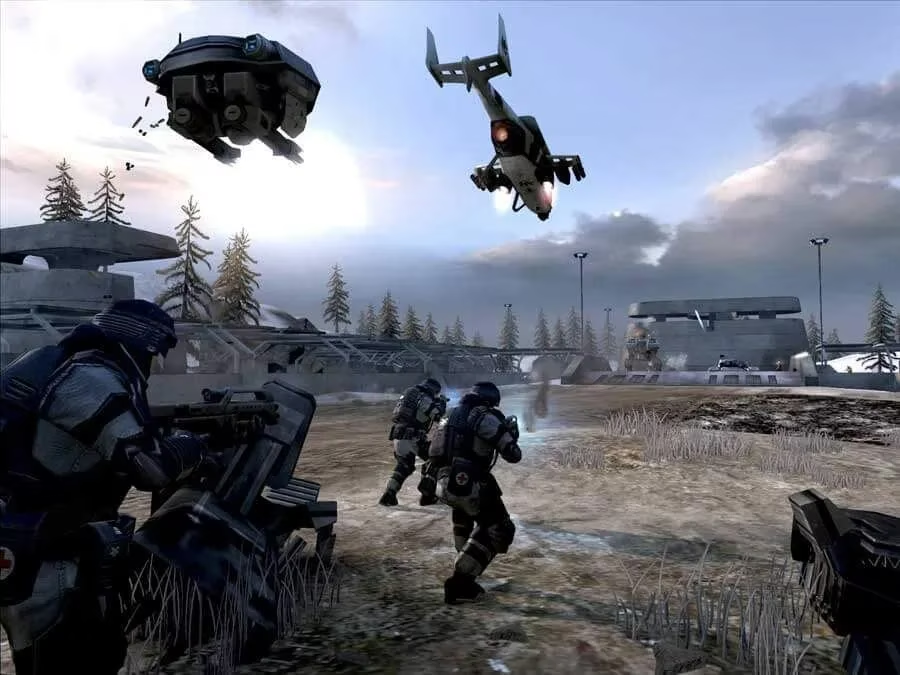
Iconic Warfare: Imagine piloting towering, rideable mechs striding across battlefields, or commanding agile hover gunships that redefine aerial combat.
-
Advanced Arsenal: Weapons could evolve from ballistic to energy-based, featuring laser rifles and plasma projectiles with unique mechanics.
-
Tactical Gadgets: Deployable energy shields, personal cloaking devices, or anti-gravity grenades could add profound new layers to squad tactics.
This direction is strategically sound. As of 2026, Battlefield's primary competitor, the Call of Duty series, has firmly re-established itself in historical and modern settings. By boldly embracing a futuristic frontier, Battlefield 2143 could stand alone, offering an experience not found elsewhere in the AAA FPS genre. It would be like a gourmet restaurant specializing in molecular cuisine opening next to a row of steakhouses—it doesn't compete on their terms; it creates its own.
Building on a Legacy
The beauty of choosing 2143 is that it's not entirely uncharted territory. The beloved Battlefield 2142 released nearly two decades ago, providing a rich foundation of lore, aesthetic, and design principles to build upon and modernize. The next Battlefield needs a powerful hook to distinguish itself in a saturated market. A confident, fully-realized plunge into a futuristic war could be the electrifying jolt needed to recapture the attention of the broader gaming world. It's time for the franchise to stop looking back with regret and start charging forward into a new dawn.
😎 Potential 2143 Feature Wishlist:
| Feature Category | Example Ideas |
|---|---|
| Vehicles | Titan-class airborne carriers, Walker assault mechs, Hover tanks |
| Gameplay Modes | Titan Assault (evolved), Orbital Drop pod invasions, Zone Control with dynamic terraforming |
| Gadgets & Tech | Active Camouflage Suits, Directed Energy Anti-Vehicle Mines, Portable Jump Pads |
In conclusion, the path forward is clear. After years of uncertainty, the Battlefield franchise must commit to a definitive vision. That vision should be ambitious, distinct, and unafraid to embrace the possibilities of tomorrow. Battlefield 2143 isn't just a nostalgic callback; it's a necessary evolution, a chance to rebuild the series as a pioneering force rather than a follower. The future, it seems, is the only way back.