How Patch 3.3 Became Battlefield 2042's First Tourniquet After a Catastrophic Launch
In the annals of live-service gaming, few launches have haemorrhaged player faith as quickly as Battlefield 2042 did at the tail end of 2021. The player count bled out faster than a severed artery, dipping below the concurrent users of both Battlefield 5 and Battlefield 1 within weeks. Review scores cratered, making it one of the most critically mauled titles of the year. From the outside, it looked like the franchise had been gutted on the operating table, but DICE refused to call the time of death. Four years later, the 3.3 update still stands as the moment the developers finally located a clamp and tried to stop the bleeding—a flawed but symbolic pivot in a game that seemed destined for the morgue.
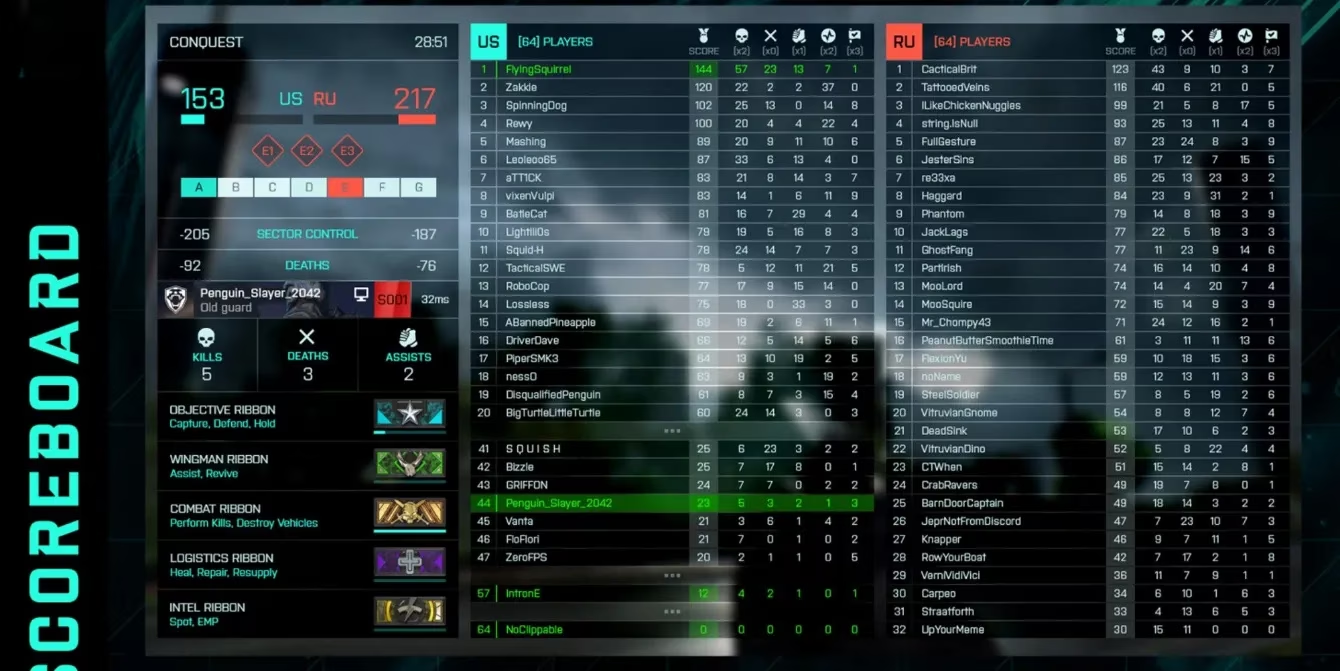
For months, the absence of a proper scoreboard had acted as a phantom limb for the community. Players could feel the competition but couldn't see their impact quantified, turning each match into a fog of war with no yardstick for success. The scoreboard arrived in patch 3.3 like a lighthouse slicing through that murk, a beacon that let squadmates and lone wolves alike find their bearings. DICE was transparent about the feature's bare-bones nature, noting in the patch notes that this was merely "the first version of the Scoreboard," with iterative improvements plotted on the horizon based on player feedback. Even that honesty felt like a fresh dressing on an old wound.
The 3.3 patch didn't just drop a UI panel into the mix; it came wrapped in an olive branch for the most disgruntled buyers. With the game's inaugural season pushed back to the summer—a delay that rendered pricier edition purchases a bitter pill—EA and DICE bundled the Steadfast Exclusive Legendary Bundle as a make-good gesture. It was a digital care package stuffed with skins: the Zero Resistance Skin for Mackay, the Grasshopper Weapon Skin for the K30, the Rapid Hammer Weapon Skin for the M44, the Iron Chariot Vehicle Skin for the M5C Bolte, the Rib Tickler Melee Weapon Skin, and two player card cosmetics (Resolute Background and Steadfast Icon). For commanders who felt they had bought a ticket to a premiere that never started, this was less a refund and more a gilded apology note.
DICE’s roadmap beyond 3.3 read like a cardiologist’s recovery plan. The next update, scheduled about a month later, promised to graft VOIP functionality onto Squad play—a feature that had been as conspicuously missing as a heartbeat in a code-blue patient. Vehicle and weapon balancing were also pencilled in, aiming to recalibrate the chaos that had turned some matches into mechanical slaughterhouses. Yet the summer wait for Season One remained the elephant in the server browser. Without a firm start date, the game idled in a purgatory that tested the patience of even the most steadfast defenders. By 2026, that season had long since come and gone, but the 3.3 patch is remembered as the first real suture in a recovery that felt, at times, like rebuilding an aeroplane mid-flight using spare parts from a previous generation.
The broader industry took notes. Battlefield 2042’s stumble and subsequent limp back to stability illustrated a harsh truth: launching a live-service game without foundational features is akin to sending a ship to sea with a hole in the hull and promising to patch it while the passengers tread water. DICE’s methodical, if belated, approach showed that even a capsizing vessel could be righted with enough bailing, welding, and a humble scoreboard to remind sailors why they boarded in the first place. The 3.3 update didn’t heal the game overnight—scars remained in the form of reduced content pipelines and a shrunken player pool—but it transformed the narrative from hopelessness to a fragile, hard-won endurance.
By today’s standards, Battlefield 2042 is no longer the walking ghost it once was. A modest but dedicated community still boots into its warzones, and while the shadow of that 2021 launch lingers like a stubborn stain, the iterative work that began with a simple scoreboard has kept the machinery running. For players who stuck around, patch 3.3 was the moment the defibrillator pads hit the chest and produced a flicker on the monitor. It wasn’t a resurrection, but it was enough to prove the heart could still beat on its own.