Battlefield 2042: From Launch Disaster to Steady Revival – A 2026 Retrospective
When Battlefield 2042 touched down in late 2021, the anticipation felt like a thousand players holding their breath before a massive drop pod launch. What followed, however, was less of a graceful landing and more of a crash into a digital sandstorm. Four years later, as 2026 unfolds, the story of this once-troubled shooter has become one of the most remarkable turnarounds in modern gaming – a salvage operation conducted under constant enemy fire.
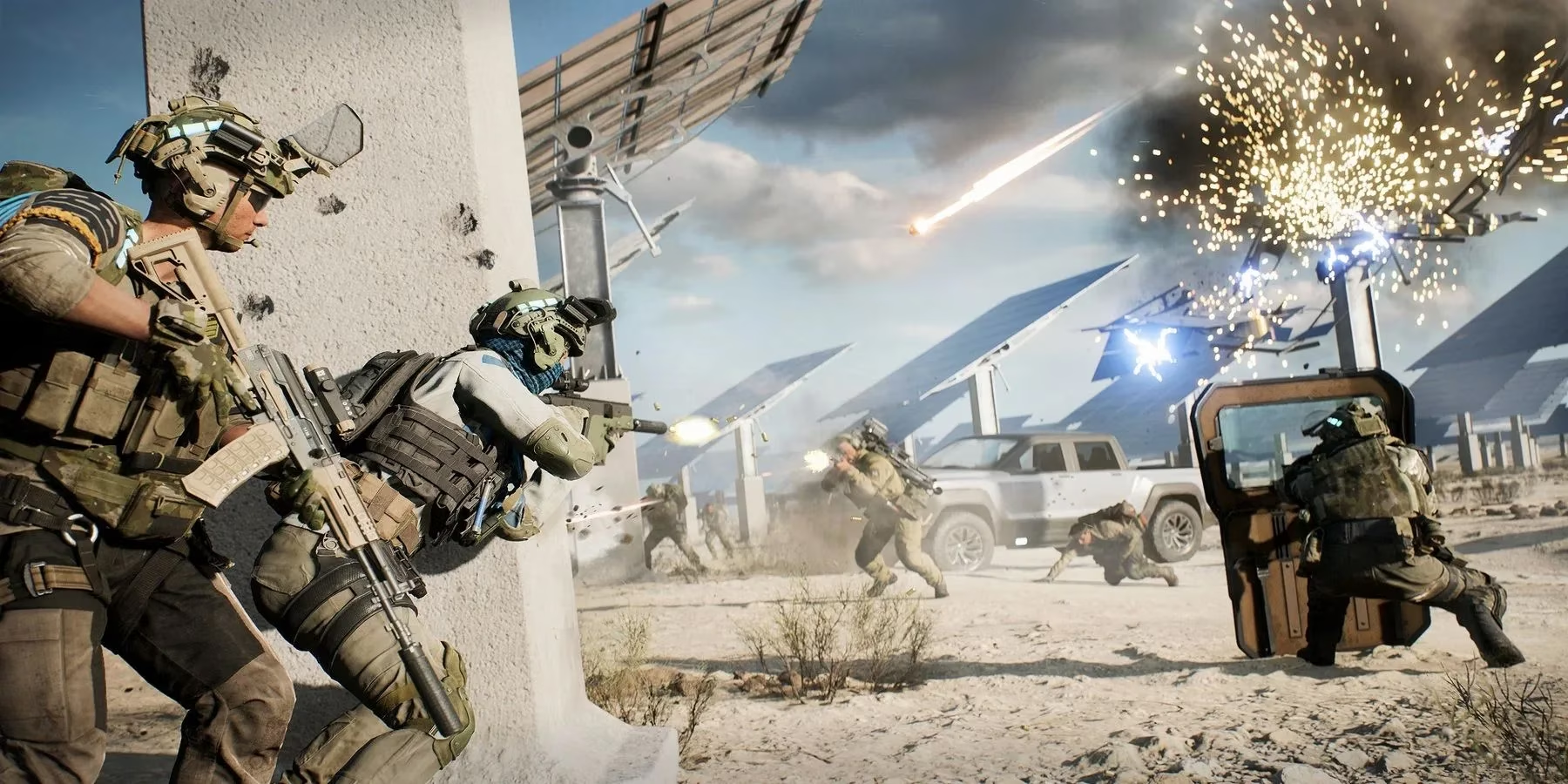
The first year was a masterclass in how not to launch a live-service game. Players were immediately confronted with a thicket of technical ailments: characters rubber-banding behind friendly teammates as if tethered by an invisible bungee cord, soldiers freezing inside fresh explosion craters like insects trapped in amber, and the grotesque sight of chest cavities rendering invisible during failed takedown animations. DICE’s January 2022 update papered over some of these wounds – the crater collision and rubber-banding were supposedly fixed – but the creeping sense of a leaky submarine persisted. Each patch seemed to plug one hole while water sprayed from three others. The takedown bug, captured in a viral clip where a player’s knife somehow tickled an enemy instead of killing them, became a dark mascot for the game’s frayed seams.
The Battlefield Portal mode, a promised playground of creative carnage, quickly turned into an XP farming field that drew DICE’s banhammer. A zombie survival mode was removed entirely after it became a frictionless loot pinata; the studio had previously disabled all progression across Portal to stop the haemorrhaging. For many, this was like watching a museum demolish its most popular exhibit because the ticket scanners kept breaking. The weapon balancing and blank-faced Specialists – a departure from the class-based soul of the series – further alienated veterans, pushing the title into an identity crisis that critics gleefully pounced on.
Yet the inflection point came not from a patch, but from a tiny rectangle in the corner of every player’s screen. The launch-era scoreboard was a fogged-up window that told you almost nothing; it refused to show deaths, couldn’t compare you to the lobby, and felt like a passive-aggressive note from a designer who hated competition. Outcry mounted, and in February 2022 DICE promised a full redesign. When the new scoreboard finally rolled out later that year, it was like installing an instrument landing system on a runway that had been shrouded in mist. Suddenly, players could see exactly how they stacked up against friends and foes – kills, deaths, revives, captures – and the feedback loop that sustains any multiplayer shooter snapped back into place. By 2024, the scoreboard had grown into a live stats hub with match history and season-long tracking, a feature that today feels as native as a rifle’s iron sights.
Parallel to this, whispers of a seismic business model shift began circulating. In early 2022, renowned insider Tom Henderson revealed that EA viewed the project as a “disappointment” and was considering making it free-to-play. The idea seemed as radical as turning an aircraft carrier into a fishing boat – but the industry was watching. Throughout 2023, EA experimented with extended free weekends and a rotating roster of no-cost access to core modes. Then, in a move that felt like a phoenix clawing its way out of the ashes of its launch sales, Battlefield 2042’s core multiplayer went permanently free-to-play in late 2024, supported by a revamped Battle Pass and a cosmetic item shop that avoided pay-to-win pitfalls. The player count, which had languished below five figures on Steam, rocketed upward like a jet fighter on full afterburner.
Today, in 2026, the game stands as a testament to stubborn iterative repair. The current version has shed its rubber-banding shackles, the takedowns are reliably lethal (no more invisible ribcages), and the crater bug is a vague memory. Zombie mode eventually returned to Portal with smart progression limits, and the mode now hosts a flourishing community of milsim and race-map creators. The Specialists have been folded back into a traditional class framework, restoring the rock-paper-scissors rhythm that made Battlefield’s squad play sing. New maps, weapons, and seasonal stories arrive on a steady cadence, and the once-mocked scoreboard is now a deep analytics playground for stat nerds.
What can other broken-to-brilliant games learn from this arc? Perhaps that even a submarine taking on water can resurface if the crew keeps bailing long enough. Battlefield 2042’s resurrection wasn’t a single heroic fix – it was a thousand small welds applied while under pressure, each one burning a little brighter until the hull finally held. As 2026’s player events and esports cups keep the battlefield loud, the game has transformed from a cautionary tale into a blueprint for live-service redemption.
Key Milestones (2021–2026)
| Year | Event | Impact |
|---|---|---|
| 2021 | Troubled launch with multiple bugs | Player backlash, declining confidence |
| 2022 | Scoreboard redesign announced & delivered | Competitive transparency restored |
| 2023 | Free weekends & Battle Pass refinement | Stabilised player base |
| 2024 | Core multiplayer goes free-to-play | Population surge, community rebirth |
| 2025–2026 | Class system revival, regular seasons | Sustained health, esports emergence |
While not every scar is invisible – some veterans still flinch at the word “Specialists” – Battlefield 2042 has carved an unlikely second life. It proves that even when a game crash-lands, diligent engineers can rebuild the wreckage into something that flies again.