Battlefield 2042: A Heartbeat That Briefly Fluttered Back
In the grand, unforgiving arena of live-service shooters, few tales are as painfully instructive as that of Battlefield 2042. By 2026, the game has become a quiet monument—not to triumph, but to how swiftly hope can flicker and fade. The story begins not in the neon-drenched futurescapes of 2042, but in the feverish autumn of 2021, when the game launched with all the bombastic confidence of a prize fighter entering the ring. Steam’s concurrent player counter—a sort of public pulse for the PC gaming world—shot past 100,000. The servers hummed with the chaos of 128-player warfare. For a fleeting moment, DICE’s vision of a multiplayer-only behemoth seemed to have actually worked.
But the fighter had a glass jaw.
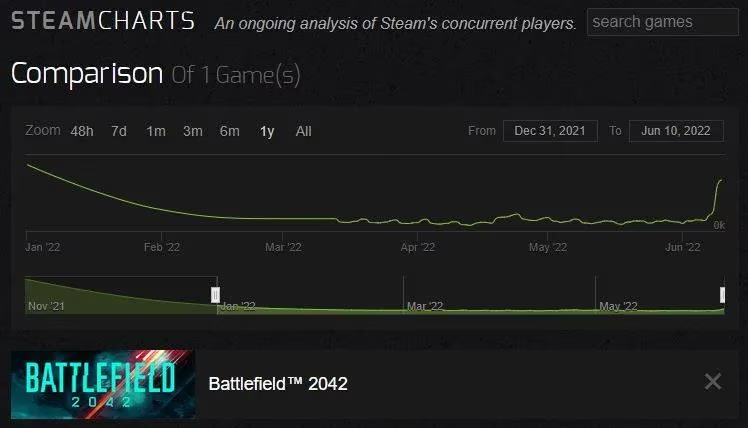
Within weeks, the cracks became chasms. Bugs that turned specialists into silent mannequins, balance that felt written by a committee of toddlers, and a painful drought of new content left players staring at their screens, wondering out loud, “Uh, is this it?” By early 2022, that mighty concurrent player heart rate on Steam had plummeted. January saw the numbers dip below 10,000—a humiliating freefall for a triple-A game barely a few months old. From mid-February onward, the pulse grew worryingly faint, hovering between a skeletal 2,000 and 3,000 players. The once-roaring battlefield had become a ghost town, where the few remaining squads could recognize each other by name. Honestly, the situation was so bleak that even the most loyal fans began whispering that the franchise itself might be on life support.
Then, like a distant ambulance siren in the fog, came Season 1: Zero Hour.
Released in June 2022, it was DICE’s first major attempt at resuscitation. A new map, a new specialist, a fresh battle pass—it was less a full transfusion and more a cautious dose of adrenaline. And for a brief, almost magical moment, it worked. The Steam charts—that unforgiving heartbeat monitor—showed a spike. For the first time in five agonizing months, the concurrent player count crawled back above 10,000, peaking near 11,000. Veterans who had uninstalled in disgust tentatively reinstalled, their curiosity piqued.
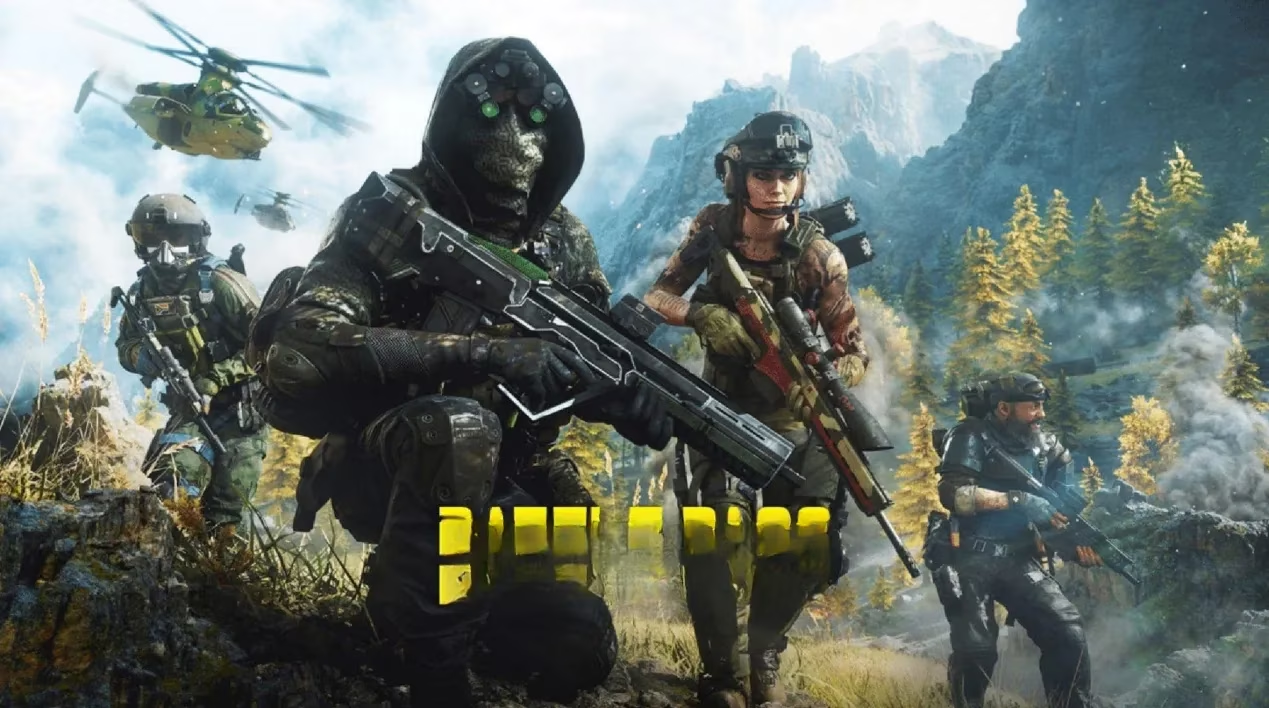
You could almost hear a collective, cautious exhale from the community. “Well, would you look at that—they actually added something.” The game’s heart gave a flutter, and a few thousand players dared to hope again. But the celebration, as it turned out, was hollow. Because while 11,000 concurrent users marked a 300% increase from the dark days of spring, it was still a pitiful fraction of the 100,000-strong army that had stormed the launch. The returning players were like scouts peeking over a trench, ready to dive back into cover at the first sign of trouble.
And trouble, as always, wasn’t far behind.
The truly damning evidence lay not in what Battlefield 2042 was doing, but in what its own predecessor was still achieving. Even after Season 1’s injection of new content, Battlefield V—a game released in 2018, abandoned and then resurrected by a skeleton crew—continued to boast a higher concurrent player count on Steam. Think about that for a second. A game that had been left for dead by its own publisher was consistently outdrawing the shiny new flagship. It was the equivalent of a retired veteran drawing a bigger crowd at a parade than the active-duty soldiers. That single statistic, cold and undeniable, told a story of broken trust that no amount of marketing spin could patch over.
The game had potential—that was the cruelest part. Beneath the rubble of poor design choices and technical debt, there were glimmers of the sandbox chaos that had defined earlier Battlefields. But potential is a fragile thing. It demands consistent nourishment, and DICE’s delivery pipeline had clogged so badly that even a successful Season 1 felt like putting a Band-Aid on a bullet wound. The community’s patience, once a deep reservoir, had been drained.
Seasons came and went after that. Season 2, Season 3… each brought a new specialist, a map rework, a handful of guns. And each time, the online heartbeat would tick up for a weekend, then slump back into its resting rate of a few thousand stalwarts. The game never died, not officially, but it settled into a quiet, unglamorous existence. By 2026, the servers are still online—you can still drop into a match of Conquest and hear the familiar crack of an M5A3—but the bustling, cross-platform community that EA had envisioned has long since evaporated. The concurrent player count, when anyone bothers to check, lingers in the low thousands on Steam, propped up only by deep discounts and a core of diehards who, bless them, have learned to love the game for what it is, not what it promised to be.
Looking back, the story of Battlefield 2042 is one of a fighter who trained for the wrong bout. It stepped into the ring with grand proclamations, took a few early hits, and then couldn’t find its footing. Season 1 was the moment the corner crew managed to stop the bleeding and get their man back on his feet, but the judges had already made up their minds. The crowd, once electric with anticipation, had mostly wandered off to other arenas. And so the fighter stands there, still swinging occasionally, but the roar of 100,000 voices has faded into a murmur of a few thousand.
In the end, the lesson is as stark as a killfeed on an empty server: in the live-service era, a game’s life is not a sprint or even a marathon—it’s a high-wire act without a net. One misstep, and the heartbeat can flatline before you even know you’re falling.